
Responsible Gaming
Games involving money can affect finances, relationships and wellbeing. This page explains warning signs and practical steps for someone concerned about gambling-related harm. It does not provide a strategy for winning or suggest that a spending plan removes the possibility of loss.
For readers in India, the prohibition on online money gaming services and related promotion remains relevant. Calling an activity responsible does not make a prohibited service lawful. Where an activity is prohibited, do not use safety information as a reason to continue it.
Gambling Is Not an Income Plan
Do not rely on games to pay rent, school costs, household bills or debt. A promotion, VIP level or referral chart does not establish dependable earnings. Money displayed in an account may also be subject to a dispute or conditions that have not been explained.
Screenshots of wins leave out information about stakes, losses and whether the funds were received. They cannot establish what will happen to another person. No verified DG Club prediction method or guaranteed-income system has been established by this website.
Signs That Gambling May Be Causing Harm
Consider seeking support if you notice patterns such as:
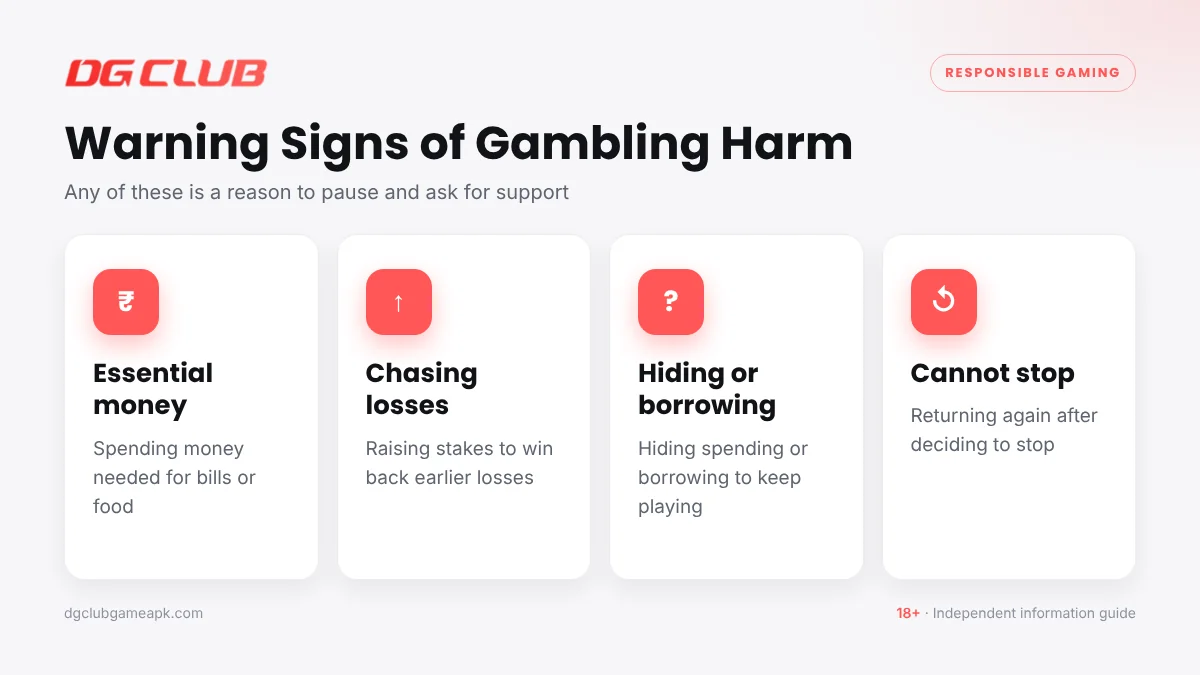
- Spending money needed for essentials.
- Borrowing or selling possessions to continue gambling.
- Increasing stakes to recover earlier losses.
- Hiding spending or arguing about it with people close to you.
- Repeatedly returning after deciding to stop.
- Feeling that gambling is affecting your health or daily > responsibilities.
You do not need to wait for a particular debt amount before asking for help. These signs are reasons to review what is happening; the page does not diagnose a medical condition or replace a professional assessment.
Stop Chasing Losses
A previous loss does not create an obligation or a reliable opportunity to win it back. Increasing the next stake can expose more money without resolving the earlier loss.
If a lost payment or withdrawal is disputed, handle it as a records and complaint question. Continuing to play or making another deposit does not establish where the original money went. Keep the transaction references separate from any claim that more activity will unlock funds.
Protect Essential Money
Review the actual amounts spent and the obligations due. Keep essential expenses and other people’s money out of gambling decisions. Avoid new borrowing as a way of recovering losses.
If debts have become difficult to manage, seek reputable debt advice appropriate to your country. Explain the gambling issue as well as the balances owed. A debt plan and support for gambling harm can address different parts of the same problem.
Ask your bank or payment provider whether suitable spending restrictions or gambling-payment controls are available. Availability varies by provider and location. A control is a practical barrier, not a guarantee that every route is blocked.
Reduce Access and Promotional Triggers
Remove unnecessary game shortcuts, stop following channels that pressure you to play and turn off promotional notifications where you can. Plan another activity for times when you usually return to the game.
Blocking software can help restrict access on supported devices. Check the publisher, scope and settings before relying on a tool. A block may not cover every website, device or payment route, so combine barriers with appropriate personal support.
Do not replace a blocked route with another account or device. If you find yourself trying to work around a barrier you chose, treat that as a reason to strengthen the support around the decision to stop.
Account Closure and Self-Exclusion
Self-exclusion generally involves asking a gambling business or participating scheme to restrict your access. Its scope and availability depend on the operator, scheme and jurisdiction.
This website has not verified DG Club self-exclusion controls, cooling-off periods or account-closure procedures. Do not assume a tool exists because another guide mentions it.
Where a verified closure or restriction route is available, keep a copy of the request and confirmation. Clarify how the process affects existing funds and personal information. Deleting an app or removing a shortcut does not necessarily close the underlying account.
Speak to Someone You Trust
Choose a person you can speak with privately and explain what has happened. Concrete information about spending, debt and the pressure to continue is more useful than trying to hide the problem until it becomes manageable on its own.
You can ask for support with practical actions, such as reviewing bills, planning time away from the game or checking that chosen barriers remain in place. Agree on boundaries that protect both people. Support does not require sharing passwords or giving an unverified person control of an account.
Professional Help and Support for Families
A qualified local health professional or established gambling-harm service can help you assess the problem and discuss support options. Availability and eligibility depend on where you live; a service described for another country may not accept your enquiry.
Family members and friends affected by someone else’s gambling may also need support. They can protect their own money, avoid sharing payment credentials and seek advice about the effect on their household. Avoid promising to cover every loss or treating another wager as the solution.
If you need urgent help for a health or safety emergency, use local emergency or urgent healthcare services. An editorial website is not an emergency or treatment service.
Children and Shared Devices
Do not provide a child with a gambling account, identity documents or payment credentials. Use appropriate device and account controls to reduce accidental access, and keep saved payment details protected.
An adult-age statement on a page is not a substitute for supervision. If a child has encountered money-gaming content or made an unauthorized payment, preserve the relevant records and contact the responsible provider through a verified route.
Be Careful with Recovery and Support Claims
Someone promising to recover losses, fix a prediction system or release funds for an advance payment may create another financial risk. Check who is contacting you and what action is actually being requested.
Do not share passwords, OTPs, payment PINs or remote device access. Keep an existing funds complaint separate from pressure to resume gambling or purchase an unverified recovery service.
A Practical Next Step
If gambling is creating financial pressure or becoming difficult to stop, step away from the game, protect essential funds and contact someone who can help. Preserve records needed for an existing dispute without treating more play as part of the recovery process.